بِسۡمِ اللهِ الرَّحۡمٰنِ الرَّحِيۡمِ
In matter connected to the Deen it is important that those who have taken up the responsibility to make decisions for their local masjid to seek the counsel of qualified scholars before acting. Matters of faith are weighty and sacred, and they require guidance grounded in sound scholarship and deep understanding.
Instead of turning to the people of knowledge, decisions are sometimes made simply by observing what others are doing or by following what has become common practice among the local community. While such practices may appear convenient or widely accepted, they do not always correspond with the rulings of authentic and reliable scholars.
Let us look into a a matter that touches a core aspect of our faith, our homes, and our places of worship, the question of our mothers, daughters, and wives attending congregational prayers in the masjid, including the upcoming Eid prayers, according to the Hanafi madhhab. In an age where the world pulls us toward every distraction, where fitnah whispers from every corner, the fuqahāʾ of ahl al-Sunnah have preserved a mercy for us, a shield for our women's purity and our families' tranquility. This is not mere restriction, but wisdom wrapped in compassion, echoing the Prophet's  tender guidance: "Do not prevent the female servants of Allah from the mosques of Allah, but their houses are better for them" (Abū Dāwūd).
Imagine the scene in Madīnah, those golden days when Asmaʾ bint Abi Bakr, Umm Salama, and other righteous women would hasten to the masjid behind the Prophet , their hearts ablaze with imān, veiled in utmost modesty, in a society bathed in taqwā. Yet even then, the Messenger of Allah , in his infinite mercy, declared their prayer in the deepest corner of their homes twenty-seven times superior to the masjid's—yes, twenty-seven times, as narrated in Muslim! This is the Sunnah's heartbeat: permission granted, but elevation urged at home, where a woman's supplication rises like a private whisper to the Ar-Raḥmān. The Qurʾān itself calls tenderly, "And abide in your homes and do not display yourselves as [was] the display of the former times of ignorance" (33:33), a verse that later Hanafis like al-Sarakhsī (d. 483 H) in al-Mabsūṭ held as abrogating public emergence when fitnah looms.
Oh, how our hearts ache thinking of the trials our sisters face today! The streets alive with gazes that pierce, social media's endless temptations, the subtle adornments that turn a simple outing into a snare. Our classical imāms, those beacons of fiqh, foresaw this. Imām Abū Ḥanīfah (d. 150 H) deemed even ʿEīd attendance makrūh for women in his era. His student, Imām Muḥammad al-Shaybānī (d. 189 H), in al-Āthār, prohibited khurūj on the two ʿEīds, citing āyat al-qaʿūd and fitnah's inevitability. Al-Kāsānī (d. 587 H) in Badāʾiʿ al-Ṣanāʾiʿ called it makrūh due to the Prophet's ﷺ emphasis on home. Al-Marghīnānī (d. 593 H) in al-Hidāyah ruled it impermissible outright. And Ibn al-Humām (d. 861 H) in Fath al-Qadīr wept over our times' lost chastity: "Piety and purity are absent today; prohibit all women."
Ibn ʿĀbidīn (d. 1252 H), the mujtahid of his age in Radd al-Muḥtār, sealed it with categorical prohibition, for what leads to harām is harām. These are not chains, dear ones, but wings—protecting our women from the dunyā's storms, just as ʿUmar ibn al-Khaṭṭāb raḥimahullāh barred them from the masjid in his caliphate, fearing fitnah's flood.
Classical Hanafi Rulings Summary
Early Hanafi early scholar allowed limited attendance for elderly (shawābb) women or specific prayers like ʿEīd/Jumuʿah under conditions, but later Hanafi scholars universally prohibited it due to fitnah.
Hadrat ‘Abdullah ibn ‘Umar  narrated that the Messenger of Allah said: "Do not prevent your women from going to the mosque, although their homes are better for them." (Abu Dawud: 565; authenticated by al-Ḥākim, Ibn Khuzaymah, and Dhahabī).
Sayyidunā ʿUmar ibn al-Khaṭṭāb felt that the concession given to women for attending congregational prayers in the mosque was being misused and could lead to greater misuse. Women were no longer adhering to Sharʿī requirements as in the Prophet's ﷺ time, and he recalled the Messenger's ﷺ advice for women to pray at home. Thus, he ruled that women should no longer attend congregational prayers in the masjid, and this was collectively endorsed by the Companions. (From Imām al-Aynī d. 855 H in ʿUmdat al-Qārī (3/228):
Hadrat A’isha  said: “If the Messenger of Allah was alive to see what women are doing now (in A’isha’s time), he would surely have prevented them from attending the prayers in the Mosque just as the women of Banu Isra’il were prevented.” (Sahih al-Bukhari and Sahih Muslim)
Hadrat Abd Allah ibn Mas’ud used to refuse women entry to the Mosque for Friday prayers and would say: “Go, your homes are better for you.” (Recorded by Imam Tabrani. See: al-Targhib wa al-Tarhib, 1/190)
- Imām Abū Ḥanīfah (d. 150 H): Regarded women's ʿEīd attendance makrūh in his time.
- Imām Muḥammad al-Shaybānī (d. 189 H) in al-Āthār: No khurūj for women on the two ʿEīds; concession existed but now makrūh for shawābb due to Qur'an 33:33 and fitnah.
- Imām al-Sarakhsī (d. 483 H) in al-Mabsūṭ: Women banned from Jumuʿah, ʿEīds, any ṣalāh per āyat al-qaʿūd; emergence leads to fitnah, which is harām.
- Imām al-Kāsānī (d. 587 H) in Badāʾiʿ al-Ṣanāʾiʿ: Makrūh for women to attend jamāʿah due to hadith and fitnah.
- Imām al-Marghīnānī (d. 593 H, al-Hidāyah): Impermissible for women.
- Imām Abū ʾl-Faḍl Majd al-Dīn al-Mawṣilī (d. 683 H) in al-Ikhtiyār: Makrūh due to "homes better" and fitnah.
- Imām Ibn al-Humām (d. 861 H) in Fath al-Qadīr: Piety/chastity absent today; prohibit all women.
- Imām al-Shurunbulālī (d. 1069 H) in Marāqī al-Falāḥ : Makrūh to even form women's jamāʿah; not permitted to attend main congregation due to fitnah.
- Al-Fatawa al-Hindiyya: “The Fatwa these days is that it is disliked for women to go to the Mosque for all prayers, due to widespread corruption.” (al-Fatawa al-Hindiyya, 1/56)
Later Hanafi scholars like Ibn ʿĀbidīn (d. 1252 H, Radd al-Muḥtār) and al-Taḥṭāwī confirm categorical prohibition for all women today.
Modern Fatāwa on the issue
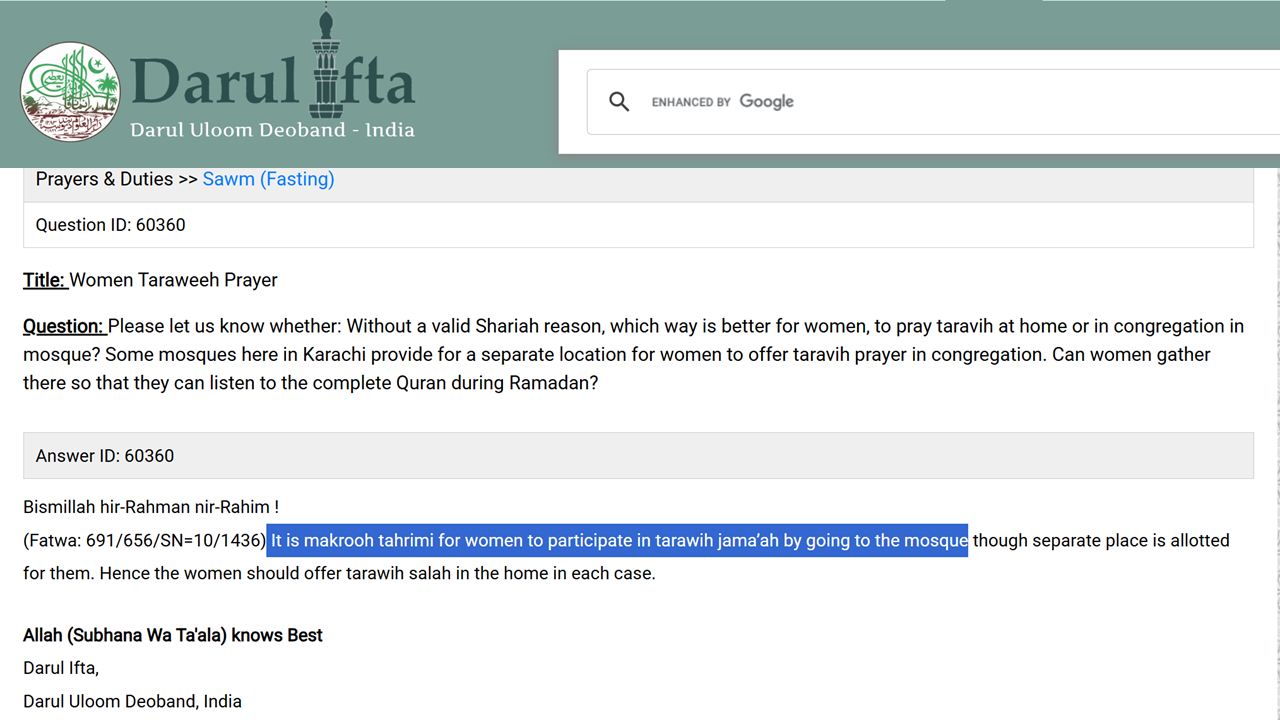
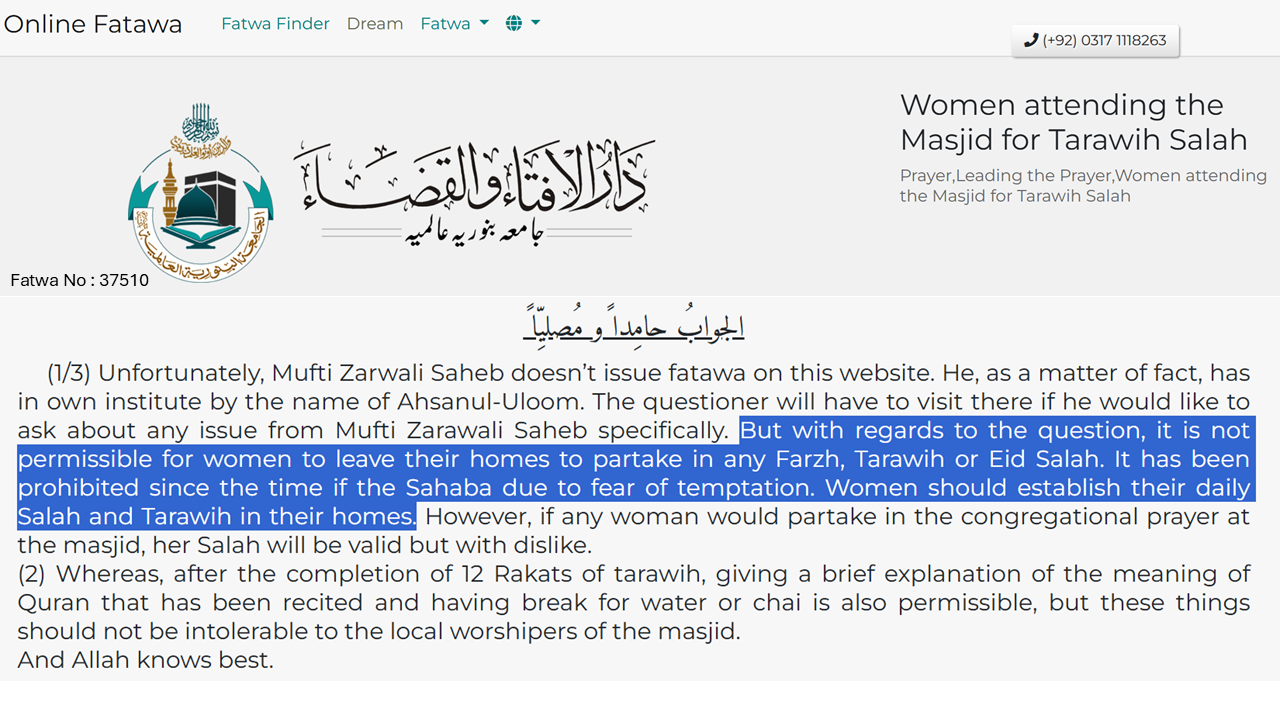
Today, the Deobandi and subcontinental ʿulamāʾ carry this torch with tearful zeal. Contemporary scholars and Darul Iftāʾ urge: unique to the Prophet's era; pray at home, in that sacred corner where Allah's gaze rests alone. Markazul Fiqh declares it makrūh taḥrīman for all ṣalāhs—Fajr to ʿIshāʾ, Tarāwīḥ, ʿEīd, even for the shawābb (elderly), in this hypersexual age of billboards and bytes. Darul Maʿārif pleads: neither attend nor invite, per the fuqahāʾ's clear decree. TheSunniWay echoes: later imāms in al-Baḥr al-Rāʾiq prohibit all. Darul Iftāʾ Deoband affirms: ṣalāh valid if done, but best at home, do not promote.
Mufti Saeed Ahmad Palanpuri: States women ideally should not attend mosques, but recognises Western realities (planning laws, loneliness, security) and says in places like America, if they do attend, they should be allowed and a stricter “no attendance” system should be applied at home, not imposed on mosques.
Mufti Taqi Usmani: Reiterates the basic principle that there is no extra virtue in women going to congregational prayers; home is better, and regular mosque attendance (including Jumuʿah) is discouraged. However, he allows women going out to learn religion with proper ḥijāb providing mosque facilities if women are already out (e.g. shopping) and would otherwise miss ṣalāh.
Sheikh Marghoob Lajpuri: Emphasises the Qurʾānic verse “And abide in your homes…” and the strength of the hadiths that home prayer is superior even to praying behind the Prophet in Masjid al‑Nabawi. He stresses that turning mosque attendance into a norm for women is against this preference, while also insisting there should still be designated mosque spaces for women, especially near markets and transport hubs, to avoid extremes like refusing even travelling women a place to pray.
Yet, mercy abounds: if a sister attends despite this, her ṣalāh is sahīḥ, no repeat needed. Husbands, fear Allah: permitting khurūj amid fitnah is sin. Masājid, do not invite; let homes become masājid of light. This is for Tarāwīḥ' nights of khatm, ʿEīd's joyous dawn, everywhere the same tender command.
Brothers and sisters, let this move you to action. Encourage your families: transform homes into gardens of ṣalāh, where women's rewards multiply unseen. In this, we honor the Salaf's path, shield our ummah's honor, and draw nearer to Allah's pleasure. May He illuminate our hearts, forgive our shortcomings, and make our homes His throne.
O Allah, Ar-Raḥmān Ar-Raḥīm, You Who soften the hardest hearts and veil Your servants in mercy, shower Your choicest blessings upon our righteous women, those tender branches of the ummah. Fortify their feet in the sanctity of their homes, multiply their hidden ṣalāḥ twenty-sevenfold, and shield them from fitnah's piercing winds. Make their private whispers to You a fortress mightier than any masjid, and transform their dwellings into lanterns of Your nūr. Forgive our lapses, ignite our love for Your Sharīʿah's wisdom, and gather us in Jannah, families united in eternal peace.
Āmīn, yā Rabb al-ʿĀlamīn.